



When choosing a wafer vs swing check valve for your pipe system, clear rules will guide your decision. You should pick a swing check valve over a wafer swing check valve if your liquid contains trapped bits or thick mud. A regular swing check valve offers a wide-open path that lets fluid pass with very little energy loss. This low pressure drop helps your pump work at its best. You also get top access to fix the valve directly inside the pipe, making repairs fast without taking the whole valve out. Use this guide to check system speed, pipe pressure, and liquid type. Picking the right design stops backward flow effectively and protects your equipment. Strong protection against backflow depends on matching the valve type to how your system works.
Key Takeaways
-
Swing check valves open completely to allow liquids to flow with very little drop in pressure.
-
Pick swing check valves for thick liquids, dirty wastewater, and fluids containing solid pieces.
-
Swing check valves have top covers with bolts that make fixing them inside the pipe quick.
-
Wafer check valves fit small spaces and lower overall pipe weight in tight designs.
-
Spring-loaded wafer valves shut fast to prevent water hammer inside fast-moving liquid pipes.
-
Choosing the right valve for your system's flow speed and liquid thickness stops expensive machine damage.
Core Differences Between Swing Check Valves and Wafer Check Valves
Flow Geometry and Area Differences
Full-Port Unrestricted Path in Swing Designs
Engineers inspect swing check valves when designing new piping systems. Inside a swing check valve, a metal disc hangs from a top hinge pin. Industrial lines rely on swing check valves to prevent unwanted liquid backflow. The internal disc moves completely away from the path to create a wide opening. Fluid glides straight through without hitting any major obstacles inside the line. TANGGONG VALVE crafts sturdy check valves using tough metals like WCB, CF8M, and Duplex Stainless Steel. Every product passes tough water pressure tests under API 598 rules to ensure top quality.
A swing check valve needs liquid pressure to keep its internal disc open. A wide inner opening lowers liquid churning and preserves movement energy. Having this full opening stops dirty buildup around the hinge parts.
Restricted Internal Area in Wafer Configurations
By contrast, wafer check valves place their inner parts straight inside the main stream. A wafer check valve uses a middle rod or springs set right in the pipe center. This setup reduces the inner opening and shrinks the total open area. These internal parts block the path, creating extra friction as liquid pushes past the disc.
Learning about different inner shapes helps you pick the correct valve model. You should weigh the pros and cons of each style before finalizing your design.
Face-to-Face Dimensions and Weight Profile
API 6D Flanged Swing Body Lay Lengths
Physical body sizes highlight major differences between these valve styles. Industry standards set official size lengths for different check valve designs. API 6D swing check valves follow ASME B16.10 rules for their end-to-end measurements. Heavy metal bodies give swing check valves extra strength against wall stress. These units need strong pipe supports to hold up their heavy weight.
Compact API 594 Wafer Profile and Piping Weight Limits
On the other hand, API 594 wafer check valves list short end-to-end sizes in their own standard charts. A dual-plate wafer check valve fits tightly between pipe flanges to lower total line weight.
|
Valve Type (Standard) |
Size (NPS) |
Pressure Class |
Face-to-Face Dimension (mm) |
|---|---|---|---|
|
Dual-Plate Wafer Type (API 594) |
4 |
150 |
73 |
|
Dual-Plate Wafer Type (API 594) |
4 |
300 |
73 |
|
Dual-Plate Wafer Type (API 594) |
4 |
600 |
79 |
|
Dual-Plate Wafer Type (API 594) |
4 |
900 |
102 |
|
Dual-Plate Wafer Type (API 594) |
4 |
1500 |
102 |
|
Dual-Plate Wafer Type (API 594) |
4 |
2500 |
105 |
|
Dual-Plate Wafer Type (API 594) |
6 |
150 |
98 |
|
Dual-Plate Wafer Type (API 594) |
6 |
300 |
98 |
|
Dual-Plate Wafer Type (API 594) |
6 |
600 |
136 |
|
Dual-Plate Wafer Type (API 594) |
6 |
900 |
159 |
|
Dual-Plate Wafer Type (API 594) |
6 |
1500 |
159 |
|
Dual-Plate Wafer Type (API 594) |
6 |
2500 |
159 |
A short wafer check valve reduces bending strain on weak pipe joints. A multi-plate wafer check valve offers a very small layout. Choosing a wafer check valve frees up useful room on offshore ships.
Pressure Drop and Flow Coefficient
Head Loss Impact Across Varying Flow Velocities
Checking pressure loss shows major performance differences in liquid systems. Flow speed directly changes energy loss across wafer check valves and swing check valves. A standard swing check valve lets liquid pass smoothly at normal pipe speeds.
System Pumping Efficiency and Flow Resistance
Comparing a wafer vs swing check valve means studying long-term pumping power costs. Lower fluid resistance improves daily system running efficiency over time. The chart below shows energy loss for a 2-inch valve under regular flow conditions.
|
Valve Type |
Pressure Drop at Rated Flow (2-inch size) |
|---|---|
|
Horizontal Swing Design |
≈ 1 psi (Cv 78) |
|
Dual-Plate Wafer Design |
≈ 1.5 psi |
A flat swing check valve gives great performance while keeping head loss very low. Using a swing check valve keeps overall running costs lower. Checking these pros and cons helps you boost your total system output. A careful study helps you pick the best valve for your factory. Your setup works better when each swing check valve functions smoothly.
Key Scenarios to Choose a Swing Check Valve
Systems Requiring Unrestricted Flow and High Cv
Gravity Feed Lines and Low-Pressure Networks
Low-pressure networks need specialized hardware to maintain continuous motion. Gravity feed lines rely on the force of gravity to move media through your piping system. Small restrictions inside a pipe slow down the entire system. You should choose a swing check valve for these applications because it creates a full flow opening. The disc inside a swing type check valve swings completely out of the stream path. Liquid moves through the body with minimal resistance. This full-port design delivers a high flow coefficient to maximize your liquid movement.
You can maintain steady performance in low-pressure networks by keeping head loss low. Gravity systems lack heavy pumps to push fluid past internal obstacles. A fully opened swing check valve gives you an unobstructed passage. Selecting swing check valves ensures your line maintains proper liquid speeds without back pressure build-up.
High-Volume Industrial Fluid Transfer Lines
High-volume flow systems move massive liquid quantities every single hour. Large commercial plants pick swing check valves to manage these continuous liquid transfers. Typical applications for swing check valves include several essential industrial installations:
-
Gas and liquid systems
-
Sewage systems (including toilets)
-
Flood prevention systems
A swing check valve provides the large flow opening required for high-volume flow operations. You reduce energy consumption across your facility when you install these valves. The wide internal body allows massive volumes of liquid to pass through smoothly. Your pumps work with less strain because the internal disc stays fully elevated during high flow rates. Careful selection of this valve style optimizes fluid movement across your entire system.
Media with Suspended Solids and Slurries
Sewage and Wastewater Processing Lines
Thick liquids with floating solids easily clog compact internal components. Raw sewage and wastewater carry debris that can destroy delicate internal mechanisms. You need a swing type check valve to handle these harsh dirty media lines. The wide flow opening allows suspended particles to travel through without trapping debris against internal support pins.
Particle size limits dictate proper equipment selection in solid-laden fluids. The table below outlines maximum particle size guidelines for axial flow wafer designs compared to dirty media requirements:
|
Condition for Axial Flow (Wafer) Check Valve |
Maximum Particle Size Guideline |
|---|---|
|
General operation to allow particles to pass easily |
Approximately 1/2 of the valve's disc lift (lift is ~1/4 of Nominal Pipe Size) |
|
High solids concentration (>25%) to avoid clogging |
Particle size should not exceed 10% of Nominal Pipe Size (NPS) |
|
Solids content of 20-30% by weight without major issues |
Particle size should be less than 5% of Nominal Pipe Size (NPS) |
A swing check valve offers much higher clear passages for heavy slurry service. Your wastewater system experiences fewer clogs when solids pass freely through the body.
Viscous Chemical and Petrochemical Streams
Viscous media and sticky petrochemical liquids create heavy drag inside narrow pipe channels. Thick oils slow down quickly when encountering internal obstructions. Selecting a swing check valve solves this fluid movement issue. The swinging disc mechanism pushes completely clear of the thick liquid path. Your viscous fluids flow smoothly through the unobstructed passageway without building up sticky residues around the hinge pin.
Proper valve selection protects your petrochemical process from unexpected line blockages. This robust valve design delivers exceptional durability when handling abrasive chemical slurries. The strong construction resists internal wear from continuous thick liquid exposure. Your industrial installation remains safe while processing aggressive compounds.
Top-Entry Inline Maintenance Demands
Bolted Bonnet Access Without Line Disassembly
Maintenance access determines how fast your crew repairs damaged components. A traditional swing check valve features a top bolted bonnet design. You simply unbolt the top cover to inspect the internal body chamber. Your technicians do not need to cut pipes or unbolt heavy pipe flanges during routine service.
This convenient top access speeds up maintenance during planned factory shut-downs. You save valuable labor hours because the main valve body stays attached to your piping structure. Your overall system downtime drops significantly during regular service checks.
In-Situ Disc Refurbishment for TANGGONG VALVE Solutions
TANGGONG VALVE manufactures durable swing type check valves for demanding industrial applications. The bolted bonnet design enables simple in-situ disc refurbishment directly inside your line. Your service crew can easily inspect, clean, or replace the internal disc without removing the body.
This simple maintenance procedure increases long-term durability and simplicity across your plant. Proper seat inspection ensures tight shut-off capabilities to stop backward flow. You extend the operational life of your equipment through simple inline servicing. Choosing TANGGONG VALVE products guarantees reliable long-term performance for all your industrial installations.
Operational Scenarios Best Suited for a Wafer Check Valve
Severe Physical Space and Piping Weight Limits
Compact Skids and Marine Piping Layouts
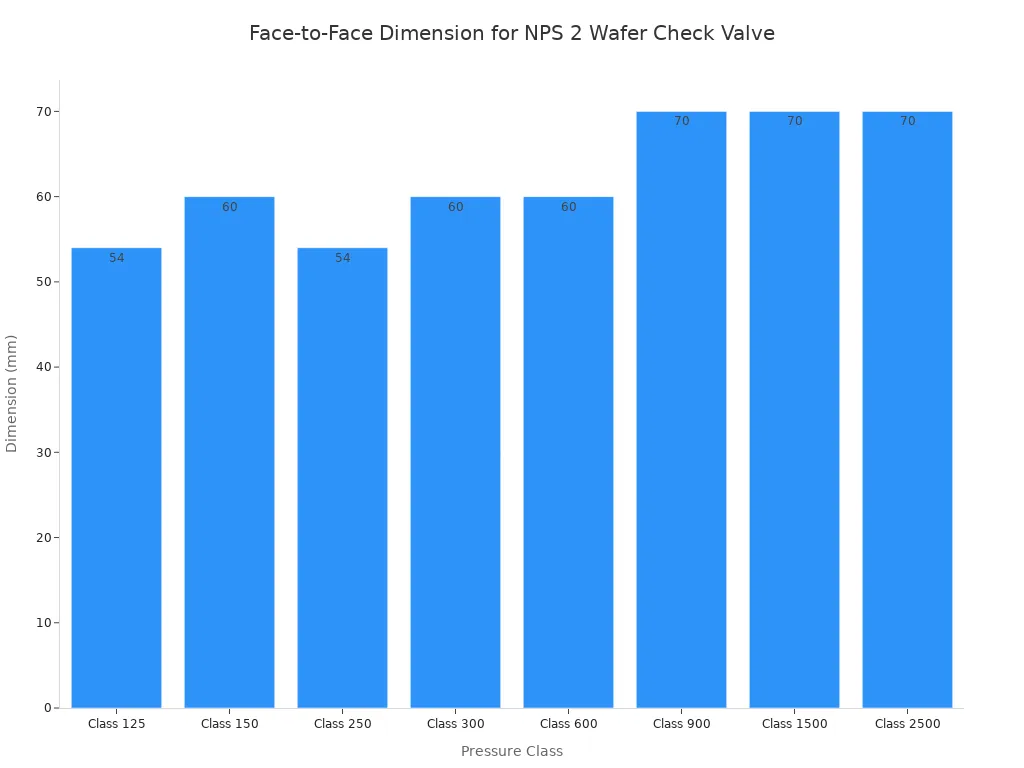
You need compact hardware when you design piping systems in tight spaces. You can choose a wafer check valve to save space. A wafer style check valve slips directly between two pipe flanges. This thin design requires minimal face-to-face space inside your layout. Per API 594, the face-to-face dimension for a 2-inch wafer check valve drops to 54 mm (2.12 inches) for Class 125 and Class 250 systems.
Engineers set up wafer check valves inside small work areas:
-
Aquariums and swimming pools
-
Power plants alongside mining sites
-
Chemical process facilities
-
HVAC systems
-
Water plants and oil setups
These typical applications benefit from short face-to-face dimensions. You save critical space on modular skids and marine ships.
Reducing Strain on Unsupported Flange Connections
Heavy valves create high mechanical stress on pipe joints. You can protect your installation by selecting lightweight wafer check valves. A wafer check valve weighs much less than a standard swing valve body. You install a wafer style check valve without extra support brackets.
This reduced weight lowers mechanical strain across unsupported pipe flanges. Your piping installation remains stable during operations. You eliminate pipe sagging and joint leaks by keeping the total line weight low.
Water Hammer Mitigation in High-Velocity Lines
Spring-Assisted Closure Prior to Flow Reversal
High fluid velocity can cause destructive pressure surges during pump shut-off. TANGGONG VALVE fits internal springs into every spring-loaded wafer check valve to solve this issue. The internal spring pushes the disc toward the seat quickly as fluid slows down. This quick closure happens right before fluid changes direction.
Selecting check valves designed to minimize rapid closure—such as silent or spring-assisted check valves—can significantly reduce the likelihood of water hammering.
This controlled quick closure prevents sudden fluid shock waves. You protect delicate system pipe walls through smooth valve action.
Eliminating Valve Slam in Pump Discharge Piping
Pump discharge lines suffer heavy mechanical wear from reverse flow slams. A standard swing disc slams shut with force. A spring-assisted wafer check valve closes quietly and gently.
The internal spring mechanism controls disc motion during flow changes. This action eliminates valve slam in pump lines. You protect your pumps and enhance overall process stability.
High-Frequency Cycling Applications
Rapid Opening and Closing Dynamic Response
Fast-cycling applications require dynamic response from your hardware. A light wafer type check valve disc responds fast to sudden pressure shifts. The compact wafer type check valve offers high reliability under continuous dynamic cycles.
You maintain optimal system performance during frequent flow starts and stops. Your check valves deliver steady performance across demanding industrial lines. Choosing a wafer type check valve optimizes quick flow control across every cycle.
When to Specify a Wafer Swing Check Valve or Dual-Plate Design
Bridging Space Savings with Swing Motion
Single-Disc Wafer Swing Configurations
Pick a wafer swing check valve to combine compact size with traditional swinging movement. A single-disc wafer swing check valve fits easily into narrow piping networks. For a 3-inch pipe size, this valve offers an end-to-end length of 16 mm. This thin layout simplifies installation between existing flanges.
Your system benefits from reduced weight during hardware selection. A swing check valve wafer type works well in tight process setups. Operators prefer this wafer style swing check valve when space limits standard flanged designs. Install a wafer swing check valve to keep liquid moving steadily in short spaces.
Hinge Pin Placement in Thin Wafer Bodies
Valve designers place the hinge pin inside the upper body shell. This internal mounting allows the single disc to swing open completely. A swing wafer check valve keeps liquid moving without requiring bulky external castings.
You prevent flow blockage by picking this unique hinge arrangement. Proper valve selection saves line space in commercial applications. A wafer swing check valve provides space-saving benefits while delivering reliable backflow protection.
Dual-Plate Spring-Loaded Alternatives
Distributed Flow Path and Reduced Disc Mass
Dual-plate designs divide fluid flow into two parallel channels. Two spring-loaded plates lower total disc weight significantly. The table below compares general performance traits between these valve configurations.
|
Valve Type |
Flow Resistance / Pressure Loss |
|---|---|
|
Swing Check Valve |
Smooth flow passage when fully open, resulting in lower pressure loss. |
|
Dual Plate Check Valve |
Slightly higher flow resistance because the discs remain within the flow path. |
Spring force closes both plates before liquid changes direction. This quick action protects your pumps across demanding industrial applications.
Selection Criteria Based on TANGGONG VALVE Standards
Pressure Class and Temperature Range Matching
You must match system conditions during part selection. TANGGONG VALVE manufactures dual-plate units for industrial processing lines. The standard models suit Class 150 pressure systems. Selecting a wafer swing check valve or dual-plate unit requires checking your line pressure.
Standard units handle operating temperatures from -20°C to 120°C. You can pick high-temperature bronze options for temperature ranges from -40°C to 150°C. Careful selection keeps your chemical processing lines safe.
Elastomer vs Metal Seat Material Selection
You check seat materials based on system liquid properties. Soft rubber seats ensure tight sealing under low pressures. Metal seats resist high heat and rough media during demanding system selection.
Correct material selection prevents early seat damage over time. TANGGONG VALVE guides your selection process to improve overall factory performance.
Consequences of Mis-Selecting Your Industrial Valve
Installing Wafer Designs in Solid-Laden Media
Hinge Pin Jamming and Spring Fouling
Choosing the wrong valve leads to major breakdowns in dirty fluid pipes. Putting wafer check valves into slurry lines creates quick risks. Heavy bits get trapped in tiny internal spaces. Solid trash quickly ruins inner springs. Floating solids collect around middle hinge pins, locking up moving parts.
The tight inner path chokes liquid movement during daily work. Stuck disc plates cannot close when flow turns around. Slurry buildup destroys your tool's basic strength. Bad installation causes complete pipe clogs and sudden plant shutdowns.
Accelerated Erosion on Sealing Elements
Fast slurry flows hit exposed inner parts head-on. Rough floating rocks wear away fragile sealing surfaces inside a small wafer check valve. Swirling dirt streams scrape disc edges and body seats.
This non-stop scraping ruins sealing quality in just weeks. You get big liquid leaks through damaged seat rings. Replacing valves often raises your factory upkeep costs.
Operating Swing Check Valves in Low-Velocity Systems
Flow-Induced Disc Flutter and Chatter
Plant workers run into unique problems when using swing check valves in slow liquid lines. Fluid flows must keep specific speeds to raise heavy inner discs fully. Low flow speeds cannot create enough push to lift them.
The chart below shows key fluid speeds for water lines:
|
Parameter |
Velocity (ft/s) for Water Service |
Description |
|---|---|---|
|
Onset of Disc Flutter |
Below ~4 ft/s |
The disc begins to flutter and hover at velocities lower than this point. |
|
Optimal Operating Range ("Sweet Spot") |
6 to 10 ft/s |
The recommended velocity range for stable, fully open operation. |
|
Minimum to Prevent Flutter |
6 ft/s |
The required velocity to hold the disc fully open and stop flutter. |
An unsupported swing check valve disc slams constantly against seat faces. This unsteady motion makes loud mechanical chatter across your pipe system.
Accelerated Pin Wear and Seat Misalignment
Non-stop disc chatter damages hinge pin setups directly. Harsh mechanical shakes wear down hinge pins fast. Loose pins ruin inner lining across sealing sides.
An off-center swing check valve lets fluid leak out when flow reverses. Repeated metal hits break structural strength over time. Bad choices lower total valve life across your setup.
Long-Term System Energy and Maintenance Losses
Increased Cumulative Pumping Costs
Picking the wrong valve hurts factory power metrics permanently. High pressure drops from a bad wafer check valve make pumps use extra power constantly. Overworked pumps waste tons of energy over long production cycles.
On the flip side, unsteady swing check valves boost system energy loss through rough flow turbulence. Smart valve choices protect system work and lower daily running costs. Right equipment choices boost factory output across every work step.
Selecting the right design depends on your exact application needs. You specify swing check valves for full flow, low head loss, thick slurries, and top-entry maintenance. Choose wafer check valves when your system faces severe space limits, weight constraints, or water hammer threats. This practical guide helps you optimize pumping efficiency and safety. Installing a proper swing check valve or wafer check valve prevents reverse flow damage. Explore TANGGONG VALVE’s broad catalog of industrial check valves for precise material selection. Our engineering team assists you with custom check valves, premium swing check valves, and versatile wafer check valves. Deploy high-performance swing check valves and space-saving wafer check valves across your plant.
FAQ
What primary benefit does a swing check valve offer in dirty water lines?
A swing check valve provides a full-port opening inside your pipe. The internal disc swings completely clear of the media stream. Thick slurries and large particles pass through this wide path without clogging hinge mechanisms.
How does a wafer check valve save space in compact piping systems?
A wafer check valve fits directly between two standard pipe flanges. API 594 standards give this design an extremely short face-to-face body dimension. You drop overall structural stress and cut extra piping weight in tight spaces.
Can you service a swing check valve without removing it from the line?
Yes, you can inspect or repair a top-entry swing check valve in place. Removing the top bolted bonnet gives your maintenance crew direct access to internal components. Technicians fix seats or replace worn discs without cutting pipes or unbolting main line flanges.
Why do engineers select a spring-assisted wafer check valve to prevent water hammer?
The internal spring mechanism closes the disc rapidly as fluid velocity drops. This quick closure occurs before flow reversal happens in your discharge line. Valve slam disappears and your piping setup stays safe from pressure surges when fluid shock waves stop.
What happens if liquid velocity stays too low in a swing check valve line?
Low fluid speed fails to lift the disc fully. Water velocities below 4 ft/s cause severe disc flutter and chatter. Hinge pins suffer damage, seat wear speeds up, high noise starts, and internal misalignments happen over time.
Which design standards govern TANGGONG VALVE check products?
TANGGONG VALVE builds products following API 594, API 6D, ASME B16.34, and BS 1868 standards. Technicians test every unit against API 598 quality rules. Facilities get reliable sealing, proper pressure classes, and durable operation from these strict industrial specifications.