



A ductile iron butterfly valve lets you control or stop liquids or gases in pipes. This valve has a strong disc that can bend and turn inside the pipe. It works better and lasts longer than cast iron valves. The table below shows how ductile iron is different from other materials:
|
Valve Type |
Material Properties |
Applications |
|---|---|---|
|
Ductile Iron |
Tougher, stronger, lasts longer |
Used for city water and medium-pressure systems |
|
Cast Iron |
Hard but not tough, cracks easily under pressure |
Used for cheap jobs and easy conditions |
|
Stainless Steel |
Resists rust, very strong |
Used for hard and tricky jobs |
If you know how this valve works and why it is special, you can pick the best one for your system.
Key Takeaways
-
Ductile iron butterfly valves help control how liquids and gases move. They work well in many places like water treatment and HVAC systems. These valves are stronger and last longer than cast iron valves. Some can last up to 25 years, so you do not need to replace them often. This helps save money. You can install them fast and easily. You can use them by hand or with machines. This lets you pick what works best for your system. Picking the right valve type is important. You can choose wafer, lug, or flanged. This makes sure it fits your pipes and works better. TANGGONG butterfly valves follow strict safety rules. This helps you feel safe when using them for city water, farming, or fire safety systems.
Ductile Iron Butterfly Valve Basics
What is a ductile iron butterfly valve
A ductile iron butterfly valve helps control water, gas, or other fluids in pipes. The valve has a round disc inside the pipe. You turn the disc to open, close, or change the flow. Ductile iron makes the valve strong and flexible. It does not crack easily and can handle more pressure than cast iron. These valves are used in water treatment plants, HVAC systems, and city water pipes.
Butterfly valves come in different types. You can pick wafer, lug, or flanged designs. Each type fits certain pipe setups. Wafer valves go between flanges and are easy to install. Lug valves let you remove pipes without taking out the valve. Flanged valves use bolts to make a tight seal.
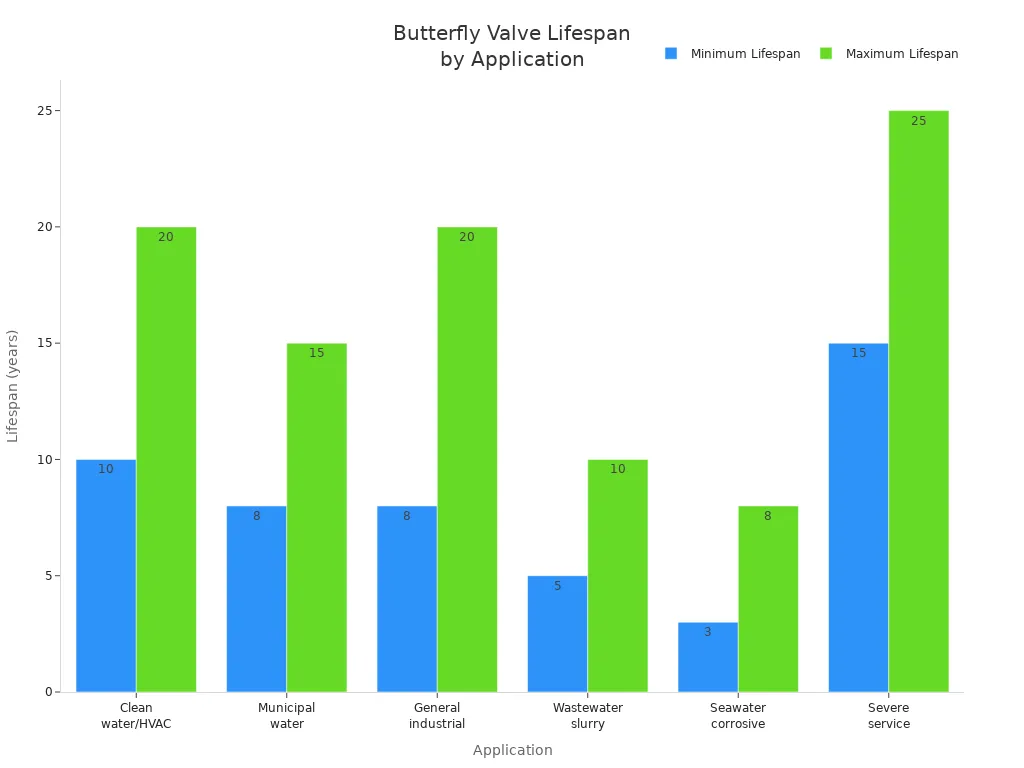
Ductile iron butterfly valves last a long time. How long depends on where you use them. For clean water or HVAC, they last 10–20 years. In city water systems, they last 8–15 years. Industrial jobs see 8–20 years. If used for wastewater or rough fluids, they last 5–10 years. In seawater or harsh places, they last 3–8 years. Some tough jobs can get up to 25 years.
Key features and benefits
Ductile iron butterfly valves have many good points. They work well, are easy to install, and are reliable. The valve seals tightly so no liquid leaks at high pressure. You save energy because the valve uses less power. You can install it fast with simple wiring and actuator mounting.
Here is a table showing important performance characteristics:
|
Performance Characteristic |
Description |
|---|---|
|
Zero Leakage Rate |
0% leakage rate at 200 psi close-off pressure ensures reliable operation throughout the valve's life. |
|
Energy Efficiency |
80% less power consumption due to patented brushless DC motor technology, saving energy and reducing costs. |
|
Installation Ease |
Quick installation with accessible wiring connections and two-bolt actuator mounting. |
|
Advanced Communication |
BACnet communication protocol provides useful data for advanced building management system control. |
|
Maintenance Cost Reduction |
Engineered for HVAC applications with a 5-year warranty, leading to lower maintenance costs. |
|
Troubleshooting Ease |
Unique position indicator allows for easy troubleshooting from long distances and various angles. |
New technology makes butterfly valves even better. Ductile iron gives more strength and stops rust. Improved sealing helps the valve work better. Lightweight parts make it easier to carry and install.
|
Advancement Type |
Description |
|---|---|
|
Materials Innovation |
Utilization of ductile iron for enhanced strength and corrosion resistance. |
|
Sealing Capabilities |
Introduction of enhanced sealing features for improved performance. |
|
Operational Features |
Development of lightweight structures and easy installation processes for better usability. |
You can use ductile iron butterfly valves in many places. Water treatment, city water, and HVAC systems all use these valves. They are also found in factories and wastewater plants.
For maintenance, wafer butterfly valves are easy to put between flanges. Lug butterfly valves let you remove pipes without taking out the valve. Wafer valves cost less because they are simple. Flanged valves cost more but seal tighter.
Tip: Pick the right butterfly valve for your system. Think about your pipes, pressure, and what fluid you need to control.
Here is a table showing typical pressure ratings for ductile iron butterfly valves:
|
Valve Type |
Pressure Rating |
Standards |
|---|---|---|
|
Ductile Iron UL/FM Valves |
300 psi |
UL/FM, AWWA C515/C508 |
|
PVC Butterfly Valves |
150 psi |
N/A |
|
UL/FM 849 Series Ductile Iron |
300 psi |
AWWA C606 |
These valves work well for water, gas, and other fluids. You save money on installation and repairs. You get good performance and easy use for many years.
Butterfly Valve Components
Main parts overview
When you look at butterfly valves, you will see several important parts that work together to control the flow of water or other fluids. Each part has a special job. Here is a table to help you understand what each part does:
|
Component |
Function |
|---|---|
|
Valve Body |
Connects to the pipeline and holds all the internal parts. |
|
Valve Disc |
Rotates to open or close the valve and control flow. |
|
Valve Stem |
Connects the actuator to the disc and moves the disc. |
|
Valve Seat |
Seals the valve when the disc closes to stop flow. |
|
Bearings |
Support the stem and help it turn smoothly. |
|
Actuator |
Provides the force to open or close the valve, either by hand or motor. |
You will find these parts in all types of butterfly valves. The valve body gives strength and connects to the pipe. The disc sits in the center and turns to let water pass or stop. The stem links the disc to the actuator, which can be a handle or a motor. The seat makes sure the valve seals tight, so no water leaks. Bearings help the stem turn easily.
Note: If you choose the right butterfly valve, you will get smooth operation and a long-lasting product.
Materials and construction
The materials used in butterfly valves affect how well they work and how long they last. Ductile iron is a popular choice because it is strong and resists breaking. Stainless steel is used when you need extra protection from rust, like in food or chemical plants. Some butterfly valves use PVC for low-cost jobs, but these do not handle high heat. Cast iron and carbon steel are also common for tough jobs. Alloy steel gives even more strength and resists damage.
|
Material |
Characteristics |
Applications |
|---|---|---|
|
Ductile Iron |
Strong, durable |
Many industrial uses |
|
Stainless Steel |
Resists rust, easy to clean |
Food and refinery |
|
PVC |
Cheap, easy to install, not for high temperatures |
Food-grade |
|
Cast Iron |
Handles high pressure and heat |
Oil and gas |
|
Carbon Steel |
Strong, resists rust |
Refineries |
|
Alloy Steel |
Very strong, resists damage |
High-durability needs |
Butterfly valves made from ductile iron follow standards like ASTM A536 and API 609. These standards make sure the valve is safe and works well in water, sewage, and other piping systems.
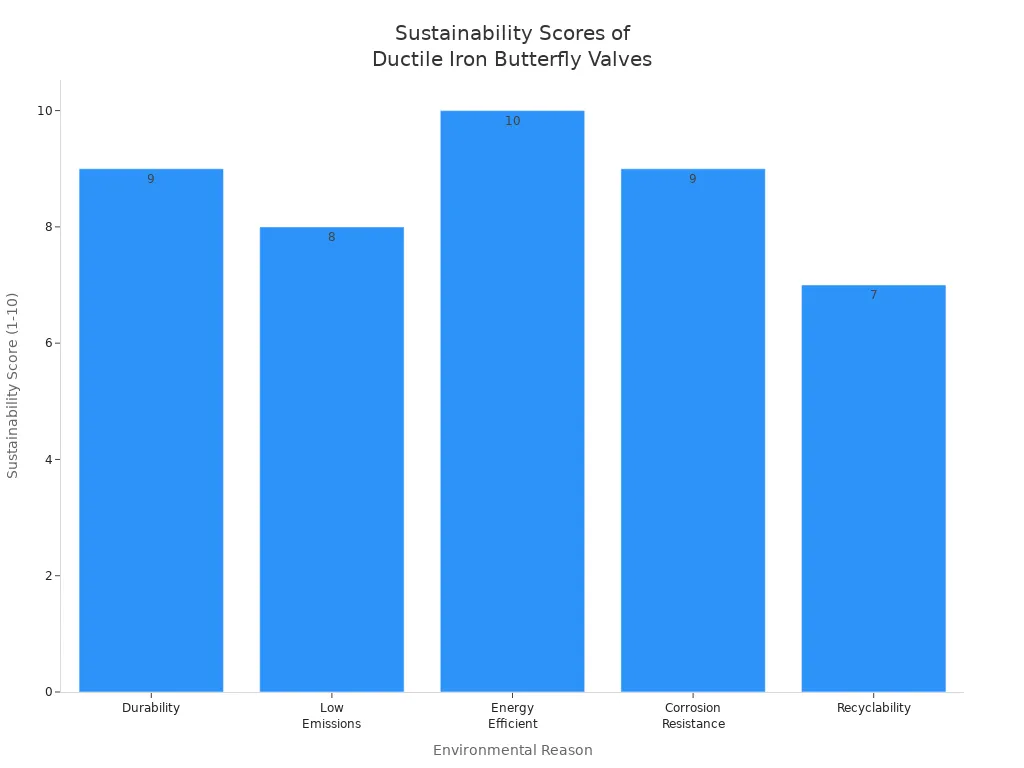
You will also see that butterfly valves help the environment. They last a long time, so you do not need to replace them often. They use less energy and resist rust, which saves resources. At the end of their life, you can recycle many of the materials.
If you install butterfly valves the right way, you avoid problems. Make sure you use the right materials and size for your pipes. This will help your valve last longer and work better with water or other fluids.
How Butterfly Valves Work
Operating principle
To understand how a butterfly valve works, look at the disc inside. When you turn the handle or actuator, the disc spins on its stem. This lets water or other fluids move through or get blocked. The disc only needs to turn a quarter of a circle to open or close. This makes butterfly valves quick and simple to use.
Butterfly valves work differently from other valves. The table below shows how they compare:
|
Valve Type |
Operating Principle |
Advantages |
|---|---|---|
|
Butterfly Valve |
Uses a rotating disc that opens or closes flow by turning 90 degrees. |
Compact, lightweight, cost-efficient, ideal for large volumes of fluid. |
|
Gate Valve |
Utilizes a gate or wedge-shaped disc that moves up and down to control flow. |
Effective for on/off control, but not suitable for throttling. |
|
Ball Valve |
Employs a spherical disc that rotates to allow or block flow. |
Provides a tight seal and is excellent for quick shut-off applications. |
Butterfly valves are lighter than other types. They fit well in big pipes and small spaces. They open and close fast, which helps in emergencies. You can also use them to control how much water flows, even if the water has tiny bits in it.
When you use a butterfly valve, you turn the stem with force. Bigger valves need more force to turn. If the valve is dry, it may be harder to move. The chart below shows how much force is needed for different sizes:
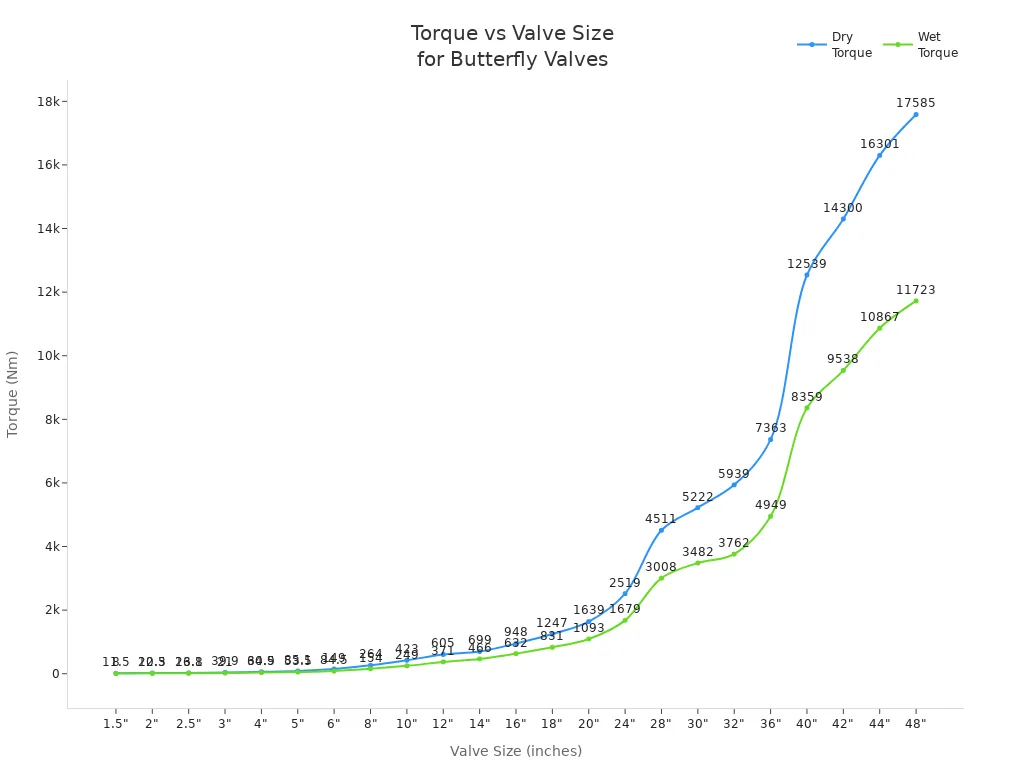
As the valve gets bigger, you need more force to turn it. This matters when you pick the right actuator for your system.
Flow control mechanism
The way butterfly valves control flow is easy to understand. You change the angle of the disc to let water pass or stop it. If the disc lines up with the flow, water moves through easily. If you turn the disc across the flow, it blocks the water.
Here are the main steps in how the flow is controlled:
-
The disc controls how much fluid moves. Its position decides if water or gas can pass.
-
The stem links the disc to the handle or actuator. It also helps keep the disc in place and stops leaks.
-
The operating mechanism lets you use the valve by hand or with a machine. This gives you good control over the flow.
You can pick different butterfly valves for different jobs. Some are best for just turning on or off. Others help you adjust the flow. The basic way they work stays the same, but the design can change.
Butterfly valves work in many places. You see them in water plants, city water pipes, and factories. They handle lots of water easily. You can also use them for gas or chemicals. Their simple design means you do not have to fix them often.
Tip: Always check the size and how much force you need before you put in a butterfly valve. This helps you choose the right actuator and makes sure the valve works well.
You can trust butterfly valves for fast and steady flow control. Their design makes them a smart pick for many jobs, especially when you need to control water or other fluids carefully.
Actuation Methods for Butterfly Valves
Manual and automated options
There are different ways to open and close a butterfly valve. You can use your hand with a handle or lever. Just turn the handle to open or close it. This is good for small valves or when you do not need to change the flow a lot. If the valve is big, you can use a gearbox. The gearbox makes it easier to turn large valves. It gives you more power, so you do not have to push as hard.
Some valves use machines to work. These are called automated actuators. Pneumatic actuators use air to move the valve. They work fast and are good when you need to control things from far away. Electric actuators use electricity. You can connect them to computers for better control. Hydraulic actuators use liquid to move the valve. They are strong and work well for big valves and high pressure.
Here is a table that shows the main actuation methods and their good and bad points:
|
Actuation Method |
Advantages |
Disadvantages |
|---|---|---|
|
Manual Actuation |
Simple, cheap, and does not need outside power. |
Not good for big valves; takes more work. |
|
Gearbox Actuation |
Makes it easier to turn big valves; gives better control. |
Costs more than manual; still needs someone to turn it. |
|
Pneumatic Actuation |
Works fast and is safe in dangerous places. |
Needs air supply; not strong enough for big jobs without extra help. |
|
Electric Actuation |
Very exact control; easy to use with machines. |
Needs electricity; costs more; not safe for places with explosions. |
|
Hydraulic Actuation |
Very strong; good for big valves and high pressure. |
Needs special liquid; more parts and costs more. |
Tip: Pick the actuation method that matches your valve size, how much water you need to move, and how often you will use the valve.
TANGGONG VALVE actuation solutions
TANGGONG VALVE has many ways to open and close butterfly valves. You can pick a manual lever for small valves. For bigger valves, you can use a worm gear. If you want the valve to work by itself, you can use pneumatic or electric actuators. Pneumatic actuators are good for factories, safety systems, and when you need to control things from far away. Electric actuators give you exact control and work well with machines.
|
Actuation Type |
Applications |
|---|---|
|
Pneumatic |
Used in factories, safety systems, remote control, and special jobs |
|
Electric |
Used in factories, safety systems, remote control, and special jobs |
TANGGONG VALVE makes sure their actuators work well and are easy to use. They design each actuator to fit the valve and the job. You can count on these actuators for water pipes, factory machines, and other tough jobs. TANGGONG VALVE checks that every actuator fits right and helps control the flow smoothly.
Advantages and Applications
Why choose TANGGONG butterfly valves
If you want a valve that works well for a long time, TANGGONG butterfly valves are a good pick. These valves are safe and reliable. They have a small size, so they fit in tight spots. You can open or close them fast with just a quarter turn. This makes them easy to use and quick to operate. The design helps water or gas move smoothly, so you do not waste energy.
It is also simple to take care of these valves. The parts are easy to check and fix if needed. TANGGONG butterfly valves last many years, even in hard jobs. They follow strict rules from around the world. You can see their certifications in the table below:
|
Certification |
Description |
|---|---|
|
ISO9001:2015 |
Quality management systems |
|
CE |
European conformity |
|
TUV |
Technical inspection and certification |
|
SGS |
Quality assurance and certification |
|
API 6D |
Pipeline valves |
|
API 607 |
Fire test for valves |
These valves are safe and high quality for many uses. TANGGONG also follows special rules for water systems, like NSF/ANSI 61 and FDA 21 CFR 177. This keeps your water clean and safe.
Tip: Pick TANGGONG butterfly valves if you want strong, useful, and certified valves for your next job.
Typical uses and industries
TANGGONG butterfly valves are used in many places and jobs. You will see them in city water pipes, plumbing, and watering farms. Farmers use them to control water or other fluids. They are also important in fire safety systems. These valves work well in medium-pressure pipes and pump stations too.
Here is a table that shows where you might use these valves:
|
Industry/Application |
Description |
|---|---|
|
Municipal water supply |
Used for efficient water distribution |
|
Plumbing |
Controls water flow in plumbing systems |
|
Irrigation |
Manages water in agricultural settings |
|
Agriculture |
Handles fluid control in farming processes |
|
Fire protection |
Key part of fire safety systems |
|
Pump stations |
Manages water flow in pump stations |
|
Medium-pressure piping |
Works in industrial piping systems |
You can find these valves in big projects. For example, tall buildings use grooved butterfly valves for fire safety. Water plants use grooved and flanged valves to make work faster and easier.
Butterfly valves help you save space and money. They also give steady and safe performance in many jobs. You can trust TANGGONG to give you good quality and safety every time.
You now know how ductile iron butterfly valves work and why they are strong. These valves can handle high pressure and last longer than cast iron. If you pick the right valve, you can save 28% on pipeline costs every year. The table below shows how ductile iron is better than cast iron:
|
Property |
Ductile Iron |
Cast Iron |
|---|---|---|
|
Tensile Strength |
Higher |
Lower |
|
Pressure Handling |
Better |
Prone to failure |
|
Durability |
Longer service life |
Shorter service life |
You get safer use, less fixing, and steady flow. TANGGONG VALVE gives you good and reliable valves for many kinds of work.
FAQ
What sizes do TANGGONG butterfly valves come in?
TANGGONG butterfly valves are made in many sizes. You can pick from DN40 (1½") up to DN3000 (120"). This means you can use them for small pipes or big pipes.
Can you use a butterfly valve for throttling flow?
Butterfly valves can help control how much fluid moves. High-performance double offset designs let you adjust flow easily. You can use them for water, gas, or other fluids.
How do you know which actuator to pick?
Choose the actuator based on the valve size and how often you use it. Manual levers are good for small valves. For bigger valves or remote jobs, use electric or pneumatic actuators.
What makes ductile iron better than cast iron for valves?
Ductile iron is stronger and bends without breaking. It does not crack when under pressure. It lasts longer and keeps you safer than cast iron.
Are TANGGONG butterfly valves certified for safety?
Yes! TANGGONG butterfly valves have certifications like ISO9001:2015, CE, API 609, and API 607. These show the valves are safe and high quality for your projects.