



Imagine you are watering your garden and the nozzle won’t shut off completely. You need a device to control the water flow. A water control valve is a mechanical device that regulates flow, pressure, or direction of water. This article explains the basic types of these valves, how they work, and how to choose the right one for your needs. You will learn about different designs and their typical uses. Knowing these basics helps you pick the right valve for any job, whether you are fixing a dripping faucet or setting up an irrigation system.
Key Takeaways
-
Water control valves manage how water flows, its pressure, or which way it moves in different systems.
-
Use on/off valves when you need to fully stop the flow. Pick regulating valves when you want to control the flow with precision.
-
Gate valves are best for fully open or fully closed use; globe valves work better for controlling flow and pressure.
-
Ball valves let a lot of fluid flow through, while butterfly valves save money for big pipes.
-
Check valves stop water from flowing backward, while pressure-reducing valves keep the pressure steady on the outlet side.
-
Choose valve materials by thinking about the fluid type, temperature, and pressure needs.
-
Choose a valve that fits the pipe size and matches your flow needs. This helps prevent pressure drops and keeps the system working well.
-
Decide between manual and automatic actuation based on your control needs and budget.

What Is a Water Control Valve?
Purpose and Function
A water control valve is a mechanical device that manages the flow, pressure, or direction of water. You use these valves to start or stop water flow. You also use them to regulate speed or prevent unwanted movement. Each valve type has a specific job. A ball valve provides full shutoff control for manual isolation. You turn the handle a quarter turn to stop water completely. A gate valve also offers full shutoff, but it works best for large flow lines. You use it to isolate sections of a main pipe. A globe valve excels at flow throttling and regulation. You can adjust it to control pressure precisely. A check valve prevents backflow automatically. It lets water move in only one direction. A pressure reducing valve maintains downstream pressure. It lowers and stabilizes the water pressure as it passes through. For automated systems, a solenoid valve offers electrically controlled shutoff. An electric ball valve provides motorized on-off shutoff for remote control.
Every valve you choose must match the task you need to perform. The valve body houses the internal parts that control the water. The disc, seat, and stem work together to open or close the flow path. Seals and packing prevent leaks around the moving parts. Understanding these functions helps you select the right valve for your plumbing, irrigation, or industrial system.
Where You Find Them
You encounter water control valves in many places every day. In your home, you find them under sinks, behind toilets, and at the main water supply line. These valves let you shut off water for repairs. They also let you adjust flow to different fixtures. In irrigation systems, valves control water delivery to different zones of your lawn or garden. You can set timers to open and close these valves automatically. This saves water and effort.
Industrial settings use valves in much larger scales. Factories, power plants, and chemical processing facilities rely on valves to manage water, steam, and other fluids. These valves handle high pressures and extreme temperatures. Municipal water distribution systems use valves to direct water through pipes. Treatment plants use them to control the flow of water through filtration and chemical treatment stages. You can find valves in commercial buildings, schools, hospitals, and farms. Wherever water moves through pipes, you need a valve to control it.
On/Off vs. Regulating Valves
You need to understand the difference between on/off valves and regulating valves. On/off valves, also called isolation valves, operate in either fully open or fully closed positions. You use them when you need to stop flow completely. You also use them when you need full flow without restriction. Ball valves, gate valves, and solenoid valves fall into this category. They work well for maintenance, emergency shutoff, or simple system control.
Regulating valves, or throttling valves, allow you to adjust the flow to any point between open and closed. A globe valve is a common example. You can partially open it to control the flow rate or pressure. This capability makes it useful for tasks that require fine adjustment. Pressure reducing valves also regulate. They maintain a constant downstream pressure regardless of fluctuations upstream. You choose an on/off valve when you need complete shutoff or full flow. You choose a regulating valve when you need precise control over the amount of water flowing through the system. Many industrial processes require this level of control for safety, efficiency, and product quality. Selecting the right control valves ensures your system operates correctly.
How Water Control Valves Work
Flow Restriction Basics
Every water control valve works by one main idea: flow restriction. You make a smaller opening inside the pipe, and water must speed up to get through. This simple action gives you control over the whole system.
Bernoulli's principle explains why this happens. When fluid moves faster, its pressure goes down. When you close a valve partway, you push water through a tighter path. The water speeds up, and its pressure drops. This pressure change is what you use to control flow.
The Venturi effect shows this same behavior in real life. Water moves from a wide area into a narrow one. Speed goes up, static pressure goes down. You see this in everyday items like garden hose nozzles. Squeeze the opening, and water shoots out faster. The same physics works inside industrial control valves.
Engineers use this idea to design valve parts. A globe valve, for example, has a curved path that creates a natural restriction. A ball valve with a partial opening makes a similar effect. The shape of the inner passage decides how much restriction you get at each position.
Pressure Management Through Throttling
Throttling means holding a valve at a middle position instead of fully open or fully closed. You use this method for pressure management in your system. By changing the opening size, you control how much pressure drops across the valve.
The theoretical pressure drop at a narrow point follows a clear relationship:
(p₁ - p₂ = ρ/2(v₂^2 - v₁^2))
Here, (ρ) stands for fluid density, (v₁) is the slower speed in the wide section, and (v₂) is the faster speed in the narrow section. This equation shows you that pressure drop grows with the square of speed change. Small changes to the valve opening cause big pressure changes.
You use this idea when you need to keep steady downstream pressure. A pressure-reducing valve uses throttling to keep output pressure constant. It senses downstream pressure and adjusts the opening on its own. This pressure management method protects equipment from pressure spikes and ensures smooth operation.
For precise throttling, you need a valve built for the job. Globe valves excel at this task because their inner shape gives fine control. Ball valves work better for on/off service because their flow changes quickly near the closed position.
Manual vs. Automatic Actuation
You can run a valve by hand or with a powered device called an actuator. Manual operation works fine for valves you adjust now and then. You turn a handle or wheel to set the position. This method costs less upfront and needs no outside power source.
Automatic control valves use actuators to move the valve stem without human help. You might pick a pneumatic actuator that uses compressed air, or an electric actuator that uses a motor. These systems respond to signals from a controller. The controller reads sensors and sends commands to position the valve exactly.
The cost gap between manual and automatic systems is large. Manual valves usually need less initial money. Automated systems have higher start-up costs but cut labor expenses and improve process consistency. For industrial uses, automatic control valves often pay for themselves through better efficiency and fewer mistakes.
You should match the actuation method to your needs. A simple irrigation system works fine with manual valves. A chemical processing plant needs automatic control valves for safety and precision. Think about your operator workload, process needs, and budget when making this choice.
Types of Water Control Valves
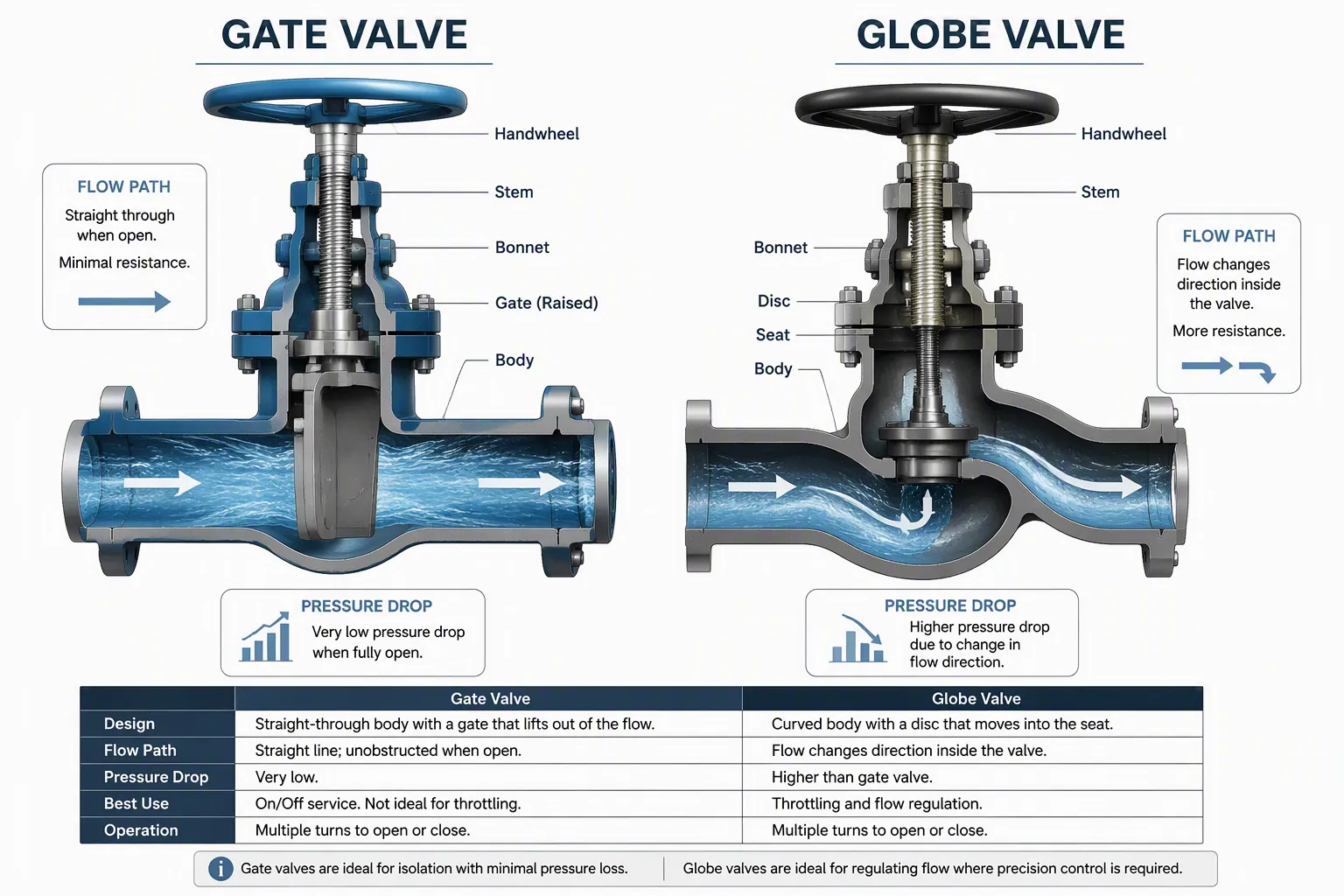
You have many choices when you need a water control valve. Each type serves a different purpose. Some valves work best for simple on/off tasks. Others excel at fine flow adjustment. Understanding the main categories helps you match the right valve to your job.
Gate and Globe Valves
Gate valves and globe valves are two of the most common designs. They look similar from the outside, but they work very differently.
A gate valve operates like a sliding door. You raise or lower a flat gate to open or close the flow path. This valve works best when you need full flow or complete shutoff. You should not use it for throttling. Partial opening causes vibration and can damage the gate over time. The flow path stays straight, so water passes through with low resistance. You will find gate valves in feedwater lines, steam systems, and general isolation service.
A globe valve has a different internal design. Water must change direction as it passes through the valve body. This creates turbulence and higher pressure loss. However, the design gives you excellent throttling control. You can hold the disc at any position to regulate flow precisely. Globe valves suit cooling water systems, chemical feed lines, and fuel oil applications. The table below summarizes the key differences.
|
Valve Type |
Primary Function |
Throttling Suitability |
Flow Path & Pressure Drop |
Typical Water System Applications |
|---|---|---|---|---|
|
Gate Valve |
On/off isolation (fully open or fully closed) |
Not recommended; difficult to control flow and risk of damage to the gate |
Straight-through path; low fluid resistance |
Feedwater, steam, slurries, viscous liquids; general isolation in water lines |
|
Globe Valve |
Stop/start and flow regulation |
Good throttling control |
Change in flow direction; high pressure loss and turbulence |
Cooling water systems, feedwater, chemical feed systems, fuel/lubricating oil systems |
Ball and Butterfly Valves
Ball valves and butterfly valves offer compact designs and quick operation. Both types rotate a closure element to control flow.
A ball valve uses a hollow sphere with a hole through the middle. You turn the handle a quarter turn to align the hole with the pipe. This action opens or closes the valve completely. Ball valves provide tight shutoff and low pressure drop. They come in full-bore and reduced-bore versions. Full-bore models have a larger opening, so they allow higher flow rates. Reduced-bore models cost less but restrict flow more.
A butterfly valve uses a rotating disc mounted on a shaft. You turn the disc to regulate flow. Butterfly valves are lightweight and inexpensive for large pipe sizes. They work well for on/off service and basic throttling.
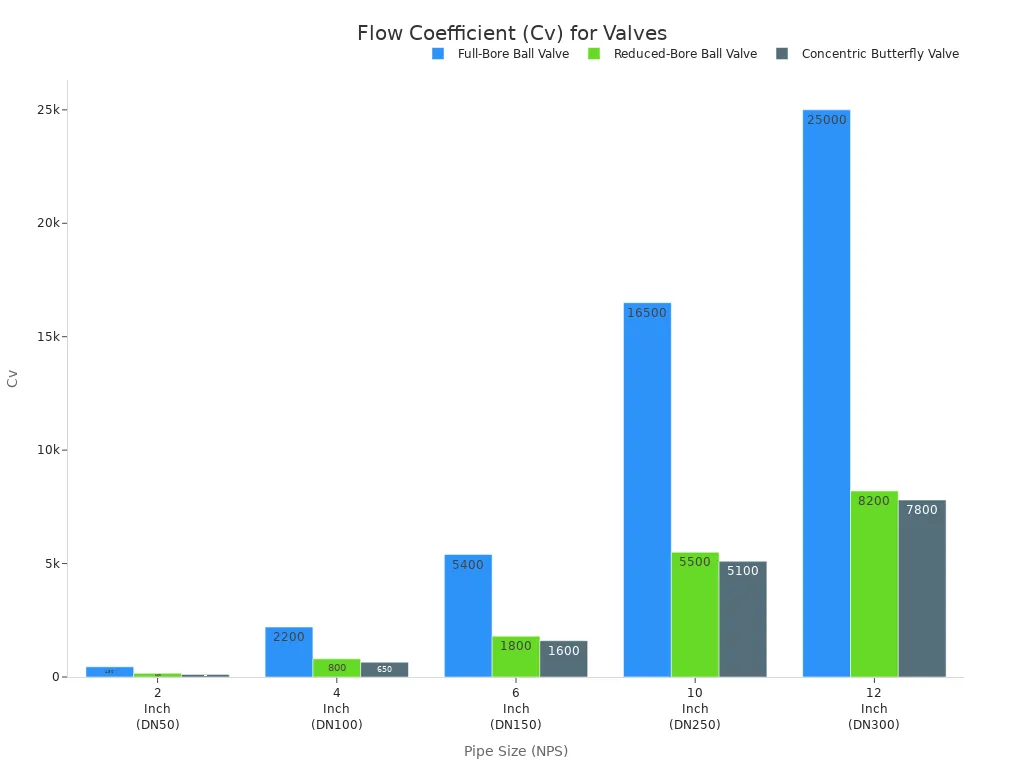
The flow coefficient, or Cv, tells you how much water a valve can pass. Higher Cv means more flow capacity. The chart below compares ball and butterfly valves across different pipe sizes.
|
Pipe Size (NPS) |
Full-Bore Ball Valve (Cv) |
Reduced-Bore Ball Valve (Cv) |
Concentric Butterfly Valve (Cv) |
|---|---|---|---|
|
2 Inch (DN50) |
450 |
160 |
115 |
|
4 Inch (DN100) |
2,200 |
800 |
650 |
|
6 Inch (DN150) |
5,400 |
1,800 |
1,600 |
|
10 Inch (DN250) |
16,500 |
5,500 |
5,100 |
|
12 Inch (DN300) |
25,000 |
8,200 |
7,800 |
You can see that full-bore ball valves offer the highest capacity. Butterfly valves provide good flow for large pipes at a lower cost.
Check and Pressure-Reducing Valves
Check valves and pressure-reducing valves serve special functions. They protect your system from damage.
A check valve allows water to flow in only one direction. It prevents backflow automatically. When water flows forward, the valve opens. When flow stops or reverses, the valve closes. You use check valves to protect pumps, prevent contamination, and maintain system pressure.
Pressure-reducing valves lower incoming pressure to a safe level. They maintain a constant downstream pressure regardless of upstream fluctuations. This pressure management protects equipment from spikes. You might also need a pressure sustaining control valve to keep minimum upstream pressure. A constant flow control valve maintains a steady flow rate even when pressure changes. These control valves work automatically without manual adjustment.
For precise industrial applications, you may need a pressure reducing control valve with an actuator. These valves respond to signals and adjust position continuously. They provide accurate control for demanding processes.
Water Control Valve Components
Every water control valve has several key parts that work together to manage flow. Knowing these parts helps you pick the right valve and keep it working well. The main parts are the body, bonnet, disc, seat, stem, and sealing parts.
Valve Body and Bonnet
The valve body is the main shell that holds the pressure. It keeps all inner parts safe and connects to the piping system. The bonnet is the cover that attaches to the body. It closes off the inner parts and lets you reach them for repairs. Together, they form the pressure barrier that holds the water inside.
The material you choose for the body and bonnet affects how long the valve lasts. Carbon steel is the most common choice for general use. It is strong and tough but still affordable. You will see it in many industrial water systems. For places with corrosion, you need austenitic stainless steel. It has at least 10 to 20 percent chromium, which stops rust. Cast iron works for low-pressure, room-temperature water jobs. It costs less but cannot handle high stress.
You must think about several things when picking materials. Corrosion types like uniform corrosion, pitting, and stress corrosion cracking can shorten valve life. Temperature and pressure ratings matter too because material strength drops as temperature rises. The table below shows common material groups and where they work best.
|
Material Group |
Typical Composition |
Durability and Application |
|---|---|---|
|
Carbon Steel |
High strength and toughness |
General industrial fluid systems at high pressure and temperature |
|
Austenitic Stainless Steel |
Excellent corrosion resistance |
Corrosive media in chemical and food processing |
|
Cast Iron |
Cost-effective, easy to machine |
Low-pressure, ambient-temperature water and steam applications |
Disc, Seat, and Stem
The disc is the moving part that opens or closes the flow path. The seat is the fixed surface that the disc presses against to seal. The stem connects the handle or actuator to the disc. It moves the disc to open or close the valve.
Common disc materials include stainless steel, cast or ductile iron, and bronze. Seats often use steel, stainless steel, or rubber compounds. EPDM rubber stretches to seal tightly against the disc. Stainless steel at the sealing point resists corrosion.
The disc and seat design decides how well the valve seals. A concentric design lines up the disc center with the seat center. It uses a soft seal like rubber or PTFE that presses evenly. This gives a tight closure for general shutoff. It works best at low pressure and temperature. A double-offset design moves the rotation axis away from the seat center. This cuts friction and wear during use. It allows metal seats for higher pressure and temperature. A triple-offset design adds a conical angle to the seat surface. It creates a frictionless seal and reaches true zero leakage. You need this design for high-temperature, corrosive media.
Seals and Packing
Seals and packing stop water from leaking around the moving stem. The stem goes through the bonnet. Without packing, water would escape at that spot. Packing material fills the space around the stem and compresses to form a seal.
You have several packing material choices. Flexible graphite packing works well for high-temperature valves in petroleum, chemical, and power plants. PTFE valve packing resists corrosive chemicals and has low friction. It needs a smooth stem surface to work well. Rubber padding packing suits temperatures below 140 degrees Celsius.
Advanced designs offer better performance. Live-loaded packing uses springs to keep steady sealing force even with temperature changes or shaking. This stops leaks over time. For toxic or expensive media, a bellows seal gives a stronger barrier. It is not a simple add-on but a full sealing solution. Combination packing with layers of graphite and reinforced PTFE extends the working range. These options handle higher temperatures and pressures while meeting emission rules.
How to Choose a Water Control Valve
Application and Flow Requirements
Know your flow needs before you pick a valve. Start by calculating the gallons per minute, or GPM, your system requires. For irrigation, use this formula: GPM = (Area × Application Rate × 453.3) ÷ Time. Area means acres, Application Rate means inches per hour, and Time means hours.
Follow these steps to find your total flow:
-
Multiply the field area in acres by the application rate in inches per hour.
-
Multiply that result by 453.3, the conversion factor for acre-inches to gallons.
-
Divide the total by the available time in hours.
-
Read the result as your required GPM.
Here is a worked example. A 5-acre field needs 1.0 inch of water per hour. You have 4 hours available. The calculation gives you (5 × 1.0 × 453.3) ÷ 4 = 566.6 GPM total. That means 113.3 GPM per acre. Your pump must deliver at least 567 GPM. A 6-inch or larger mainline is recommended for this flow.
Beyond flow rate, you must consider several other factors. These include:
-
Required flow rate, both maximum and minimum values
-
Operating pressure, which affects material and valve type
-
Fluid compatibility, such as potable water versus wastewater
-
Installation environment, including indoor or outdoor, temperature, and humidity
-
Voltage availability for automated valves
-
Need for automation, whether manual, solenoid, or electric actuation
-
Desired shutoff style, such as quarter-turn or plunger
-
Control method, including manual, sensor-triggered, or remote
-
Type of fluid, whether potable, non-potable, or chemical
-
Connection type, such as threaded, flanged, or PEX
-
Applicable regulations, including lead-free requirements and local codes
Material and Size Selection
Your fluid type drives your material choice. Potable water systems often require lead-free brass or stainless steel. Wastewater systems tolerate cast iron or ductile iron. Chemical applications demand corrosion-resistant alloys. You must also consider your installation environment. Outdoor valves need weather-resistant materials. High-temperature settings require metals that hold strength under heat.
Valve size depends on your pipe diameter and flow requirements. A valve that is too small creates excessive pressure drop. A valve that is too large costs more and may not throttle accurately. Match the valve connection to your existing piping. Threaded connections suit smaller pipes. Flanged connections work for larger industrial lines. PEX connections fit modern residential plumbing.
Actuation and Maintenance Considerations
You must decide between manual and automatic operation. Manual valves cost less upfront. You turn a handle or wheel to adjust them. They work fine for systems you rarely change. Automatic valves use an actuator to move the stem without human help. An actuator responds to signals from a controller. This setup suits remote or automated systems. You also need to consider voltage availability. Electric actuators require a power source. Pneumatic actuators need compressed air.
Think about maintenance before you buy. Some valves need regular packing adjustment. Others require periodic seal replacement. Choose a design that matches your maintenance capacity. A complex valve in a remote location creates problems. A simple valve in an accessible spot saves time.
Your choice also affects pressure management. A valve with good throttling control helps you maintain steady downstream pressure. This protects equipment from spikes. It also ensures consistent operation across your system. Match the valve's control range to your actual operating conditions. This prevents overworking the valve and extends its service life.
Control Valves for Industrial Applications

What Are Control Valves
Control valves are different from the manual valves you have read about so far. These are power-operated devices built for continuous adjustment. They change flow, pressure, temperature, or liquid level based on a control signal. You use them when a process must stay within tight limits. A simple ball valve gives you on/off control. A control valve gives you precise, ongoing adjustment.
You will find these valves in refining, petrochemical, power generation, and chemical processing plants. They handle tough conditions where manual adjustment is not possible. The valve gets a signal from a controller. That signal tells the valve how far to open or close. The valve then moves to that exact position. This cycle repeats constantly to keep the desired process condition.
The main difference from isolation valves is the ability to throttle continuously. You can hold a control valve at any position between fully open and fully closed. This makes them essential for pressure management in industrial systems. Without them, you cannot keep downstream pressure steady when upstream conditions change.
Key Features and Actuation Options
Modern control valves use cage-guided trim for better performance. The cylindrical cage guides the plug smoothly with little lateral motion. This design prevents side-load forces that cause wear and vibration. You get stable operation even under high pressure drops.
The cage also protects the valve body from cavitation and erosion damage. It acts as a shield between the flow and the body walls. Large trim sizes, ranging from 2 to 10 inches, allow high flow capacity. You can swap interchangeable cages to change the flow characteristic. This flexibility lets you customize the valve for different process needs without replacing the whole unit.
You have several actuation options for automatic control valves. A pneumatic diaphragm actuator uses compressed air for fast response. A pneumatic piston actuator delivers higher thrust for larger valves. An electric motor actuator provides precise positioning for remote or automated plants. Each actuator type converts a control signal into stem movement. You can choose based on your available utilities and response needs.
These valves support multiple control signals. You can use 4–20 mA analog signals or digital protocols like HART, Modbus, and Profibus. This compatibility makes integration with modern control systems easy.
TANGGONG Control Valve Solutions
TANGGONG offers a full line of control valves built for industrial precision. Their valves range from DN15 to DN600, covering ½ inch to 24 inch pipe sizes. Pressure classes span from Class 150 to Class 2500. You can handle pressures from PN10 up to PN420. Temperature ratings extend from -196°C to 650°C, depending on your trim and seat material choice.
You can select body materials to match your process fluid. Options include WCB, WC6, WC9, CF8, CF8M, CF3, CF3M, LCB, and LCC. Trim materials range from SS304 and SS316 to hardened options like Stellite 6 and Tungsten Carbide. This variety ensures you find a compatible combination for corrosive or abrasive media.
TANGGONG control valves meet ANSI/FCI 70-2 shutoff standards. They comply with IEC 60534 sizing calculations. You can choose shutoff classes IV, V, or VI based on your leakage needs. Flow characteristics include linear, equal percentage, and quick opening. The valves are factory-calibrated and tested to API 598 standards before shipment.
Certifications include ISO 9001:2015, CE, and SGS. The valves are SIL-capable per IEC 61508. You also get free valve sizing consultations based on IEC 60534 standards. This support ensures you pick the right valve for your specific process conditions.
Whether you need a pressure reducing control valve, a pressure sustaining control valve, or a constant flow control valve, TANGGONG provides engineered solutions. Their 36 years of experience and 200 national patents back every product. You get reliability and precision for your most demanding applications.
Applications of Water Control Valves
Residential and Irrigation Systems
You can find water control valves in nearly every home. Ball valves give you fast quarter-turn shutoff for supply lines and appliance isolation. Check valves stop reverse flow that could harm pumps or water heaters. Pressure reducing valves bring incoming pressure down to a safe level for your plumbing. Float valves manage water levels in toilet tanks automatically. These valves help you control water use and protect your equipment.
Irrigation systems use automatic control valves to send water to different zones. You set a timer to open and close these valves at set times. This saves water and cuts down on waste. Good water supply management in your yard prevents overwatering and runoff. It also lowers your water bill. Many systems use solenoid valves for remote control. These valves respond to electrical signals from a controller. They make it simple to change watering schedules without manual work. By using the right valves, you get efficient water supply and reduce water loss from leaks or overspray.
Industrial Process Control
Industrial plants depend on control valves for exact process regulation. These valves adjust flow, pressure, temperature, or liquid level. Each industry has its own needs. Chemical processing requires hazardous area certifications like ATEX or IECEx. Pharmaceutical facilities need ISO 9001:2015 quality management and validation support. Food and beverage operations require NEMA 4X and IP 65 ratings for washdown environments. Oil and gas applications need wide pressure and temperature ranges. Water and wastewater plants require low-pressure operation down to 0 psig and manual override for emergencies. Pulp and paper mills need high humidity resistance and durability for 20 million cycles.
A rotary globe valve in food processing achieves 100:1 rangeability. It handles flow changes from 10,000 to 2,000 pounds per hour while keeping tight temperature control. This valve meets FCI ANSI Class V shutoff, preventing water hammer and bacteria growth. It lets you standardize across a plant, reducing spare parts inventory. For precise pressure management, you might use a pressure reducing control valve. It keeps downstream pressure constant even when upstream conditions change. This protects sensitive equipment and ensures consistent product quality.
Municipal Water Distribution
Municipal systems use valves to direct water through pipe networks. They control flow from treatment plants to storage tanks and then to homes and businesses. Proper water supply management ensures every customer gets adequate pressure and volume. Control valves in these systems regulate pressure in different zones. They prevent pipe bursts and maintain service reliability.
A pressure reducing control valve is vital for keeping safe pressure in lower elevation areas. It lowers high upstream pressure to a stable downstream level. This protects household plumbing and reduces water loss from leaks. Municipal operators also use check valves to prevent backflow, which can contaminate the supply. They install automatic valves for remote operation, reducing the need for manual adjustments. Efficient water supply depends on well-maintained valves that respond quickly to changing demands. This minimizes waste and ensures consistent service to thousands of customers.
A water control valve regulates flow and pressure by restricting the passage of water. You have many types to choose from, including gate, ball, globe, and butterfly designs. Each serves a different purpose.
Matching the valve type to your application matters greatly. A simple ball valve works for home shutoff. Industrial processes demand precision. Specialized control valves from TANGGONG offer continuous modulation for these demanding needs. They handle high pressures and temperatures with accuracy.
Good water supply management reduces water loss and ensures efficient water supply. Choose wisely for your specific situation.
Do you have questions about selecting the right valve? Share your experiences in the comments below.
FAQ
What is the difference between an on/off valve and a regulating valve?
On/off valves only work fully open or fully closed. You use them to isolate parts of a system or for emergency shutoff. Regulating valves let you set any position between open and closed. You use them when you need exact flow or pressure control.
How does a water control valve work?
Every water control valve works by limiting flow. The valve makes a smaller opening inside the pipe. Water moves faster when it passes through the narrow space. This change in pressure lets you control flow and pressure.
What type of valve works best for throttling?
A globe valve is best for throttling. Its inner design creates a curved path for water. This gives you fine control over the opening position. You can adjust it exactly to keep the flow or pressure you want.
What is the difference between a control valve and a shut-off valve?
A control valve changes flow continuously to keep a process steady. It uses a control signal to set its position. A shut-off valve only opens or closes. It gives a tight seal when fully closed.
What materials should I choose for my water control valve?
Carbon steel works for most industrial jobs. Stainless steel resists rust from harsh fluids. Cast iron suits low-pressure, room-temperature water. Pick a material that matches your fluid type and where you use it.
How do I choose between manual and automatic actuation?
Manual valves cost less at first. You turn a handle or wheel to adjust them. Automatic valves use actuators like pneumatic or electric models. They respond to signals from a controller. Choose based on your process needs and budget.