



Plant managers and process engineers face tough choices when picking control valve manufacturers in 2026. You must balance system performance with operational risk. Checking key valve selection criteria like flow coefficient precision, proper metallurgy selection, Industry 4.0 smart actuation, and total cost of ownership ensures long-term success. The global control valve market size will reach USD 11.11 billion in 2026, driven by strict processing needs.
As an established custom valve manufacturer, TANGGONG VALVE stands among the leading global control valve manufacturers, bringing over 36 years of experience and a 175,000 square meter factory to solve complex flow challenges. Choosing the right vendor prevents sudden downtime, stops severe service problems, and keeps full compliance with international safety codes.
Key Takeaways
-
Use the STAMPED method to pick the correct valve size and material.
-
Choose the right flow coefficients to make sure your system stays safe and works smoothly.
-
Use strong metal blends to stop valve wear and chemical damage.
-
Add smart positioners to check valve health and stop sudden breakdowns.
-
Purchase approved safety valves to stop dangerous leaks and gas explosions.
-
Choose good valves to cut your overall repair costs over time.
-
Work with reliable companies like TANGGONG VALVE to get helpful advice from their expert technical team.
Technical Sizing and Engineering Rigor

Plant managers and process engineers must apply strict design principles when selecting flow control hardware. You need structured evaluation frameworks to match equipment parameters with demanding process requirements. A failure during initial planning directly leads to unexpected plant shutdowns and safety hazards. Proper application-based valve selection prevents severe maintenance problems and maximizes system efficiency. Engineers follow the STAMPED methodology to standardize this decision process.
|
STAMPED Step |
Engineering Criteria |
|---|---|
|
S - Size |
Select valve size based on required flow capacity using the flow coefficient (Cᵥ); consider how orifice size affects flow resistance. |
|
T - Temperature |
Evaluate both media and ambient temperatures; account for thermal expansion, material strength drops, and seal degradation. |
|
A - Application |
Define the primary valve function, such as start/stop, throttling, flow regulation, or overpressure protection. |
|
M - Media |
Confirm chemical compatibility between process fluids and wetted materials to avoid corrosion and stress cracking. |
|
P - Pressure |
Match working and design pressures; recognize that allowable valve pressure ratings drop as temperature increases. |
|
E - Ends |
Select flange, welded, or threaded end connections that match piping standards and prevent leakage paths. |
|
D - Delivery |
Factor lead time and logistics into project schedules to keep system installation on schedule. |
Precision Sizing and Hydrodynamic Calculations
Flow Coefficient (Cᵥ) and Rangeability
Accurate sizing matches the valve capacity to process requirements. For non-flashing, turbulent liquid flow, IEC 60534-2-1 defines the flow coefficient as Cv = Q * sqrt(SG / dP). In this formula, Q is the volumetric flow rate in US GPM, SG is the fluid relative specific gravity, and dP is the pressure drop across the valve in psi.
Sizing errors directly compromise control loop stability:
-
Undersized valves cannot pass the required maximum flow rate even when fully open.
-
Oversized valves operate below 20% open, causing loop instability, rapid seat wear, and poor process control.
To avoid these issues, TANGGONG VALVE offers complimentary IEC 60534-compliant sizing consultation services for complex process conditions.
Pressure Recovery and Choked Flow
High pressure drops inside a valve body cause localized fluid acceleration. When the pressure drops below the fluid vapor pressure, liquid transforms into vapor bubbles. As the fluid downstream recovers pressure, these bubbles collapse violently. This action creates cavitation, which destroys internal metal parts.
Modern software solutions like FluidFlow implement ISA-75.01.01 and IEC 60534 equations to detect choked flow and liquid cavitation indices. Evaluating these hydrodynamic forces ensures your control valve maintains precise regulation without structural damage.
Metallurgy and Trim Material Selection
Erosion and Corrosion Resistance
Process fluids demand robust chemical and physical properties from internal valve components. Standard carbon steel bodies handle non-corrosive liquids, but aggressive chemical processes require advanced stainless steels and custom alloys. Selecting the correct materials ensures long service life and maintains system safety.
|
Trim Material / Treatment |
Recommended Service |
Key Selection Criterion |
|---|---|---|
|
Type 316 Stainless Steel |
Liquids and gases corrosive to carbon steel |
Excellent general corrosion resistance |
|
17-4PH Stainless Steel |
High-pressure fluids and abrasive slurries |
High yield strength and erosion resistance |
|
Full Stellite Hard-Facing |
Abrasive, erosive, and high-velocity fluids |
Superior wear resistance up to severe thermal limits |
|
Tungsten Carbide |
Extreme slurry and abrasive fluid applications |
Highest hardness range (65–75 HRC) for extreme wear |
Hardfacing and Exotic Alloy Options
Severe service conditions require hardfacing treatments to extend component operational life. Applying full Stellite 6 or Tungsten Carbide to internal trims creates an extremely durable surface. In severe erosive or high-pressure-drop services, hard-faced valve seats outlast standard trim materials by 5 to 10 times.
As a trusted custom valve manufacturer, TANGGONG VALVE manufactures durable trim options across pressure classes from Class 150 to Class 2500 (DN15–DN600). The company delivers tailored metallurgy solutions using WCB, WC6, WC9, CF8, CF8M, LCB, and LCC body materials.
Smart Actuation and Digital Positioners
HART, Modbus, and Fieldbus Integration
Modern automation systems depend on digital positioners to deliver continuous stem feedback and dynamic control. Choosing the right communications protocol determines how your digital positioner interacts with plant controllers.
|
Protocol |
Signal Type |
Topology |
Setup Complexity |
Primary Use Case |
|---|---|---|---|---|
|
HART |
Hybrid: 4–20 mA analog digital |
Point-to-point |
Low |
Upgrades and single-loop control |
|
Foundation Fieldbus |
Fully digital |
Multi-drop trunk |
High |
Large greenfield plants with complex loops |
|
Profibus PA |
Fully digital |
Multi-drop / star / tree |
Medium |
Hybrid process plants and automated facilities |
Edge Analytics and Health Monitoring
Smart digital positioners record real-time actuator pressure, stem travel, and dynamic friction profiles. Edge analytics process this data continuously to detect packing degradation, seat wear, and supply pressure fluctuations before failure occurs. Working with an experienced control valve supplier helps plant operators integrate predictive health monitoring directly into their distributed control systems. TANGGONG VALVE acts as an experienced control valve supplier, equipping modern positioners to deliver long-term reliability for critical process loops.
Standards, Certifications, and Safety Compliance
Process engineers must evaluate international technical safety specifications when selecting valve hardware. Choosing a certified control valve supplier ensures your equipment operates safely under high pressures, extreme temperatures, and severe operating environments.
Industrial Code Compliance
ASME B16.34 and API 6D Codes
ASME B16.34 establishes foundational design rules for pressure-containing valve components. This standard defines precise pressure-temperature ratings, minimum body wall thicknesses, and material mechanical properties across all pressure classes. pipeline valves certified under API 6D fulfill strict dimensional, manufacturing, and design requirements for cross-country pipelines and production facilities. Compliance with these standards guarantees that valve housings safely withstand internal process forces.
ATEX and Hazardous Area Ratings
Refinery and chemical plant environments frequently contain explosive gas or dust atmospheres. Electrical positioners and pneumatic actuators require proper ATEX certification before installation in these hazardous locations. Equipment designs eliminate potential electrical sparks and hot surface temperatures. Selecting ATEX-rated valve assemblies protects facility personnel and infrastructure from catastrophic ignition hazards.
Functional Safety and Emissions
SIL Capability per IEC 61508
Safety Instrumented Functions (SIFs) protect industrial processes from dangerous overpressure events. A control valve used as a final element must meet strict Safety Integrity Level (SIL) targets established under IEC 61508 and IEC 61511 standards.
|
Standard |
Effect on valve specification |
Effect on compliance |
|---|---|---|
|
ISO 15848-1 |
Defines tightness classes A, B, and C, temperature ratings, and endurance limits for stem and body seals. |
Serves as the standard type-test certification for stem leakage, verified via valid third-party certificates. |
|
IEC 61508 SIL |
Defines failure-rate parameters and diagnostic coverage for safety functions like emergency shutdown service. |
Requires third-party FMEDA assessments to prove functional safety capabilities for system risk reduction. |
Bare valves without diagnostic tools are limited to SIL 1 capability. Adding dynamic digital valve controllers enables partial stroke testing, elevating equipment capabilities to SIL 2 or SIL 3 levels.
SIL 2: PFDavg range 0.01 to 0.001 (Risk Reduction Factor 100 to 1,000)
SIL 3: PFDavg range 0.001 to 0.0001 (Risk Reduction Factor 1,000 to 10,000)
ISO 15848-1 Fugitive Emission Seals
Volatile organic compound (VOC) leaks harm the environment and waste costly process fluids. ISO 15848-1 establishes clear testing procedures to measure fugitive emissions through valve stem packing sets under dynamic thermal cycling. Buying ISO 15848-1 certified valves helps your plant maintain environmental compliance with strict regional EPA and EU emission limits.
Testing and Quality Assurance
Radiographic and NDT Testing
Your control valve supplier uses non-destructive testing (NDT) to inspect critical casting and forging integrity. Technicians perform dye-penetrant, magnetic-particle, and radiographic testing to locate internal voids, inclusions, or surface cracks before final machining.
ANSI/FCI 70-2 Seat Leakage Validation
Pressure Equipment Directive (PED) 2014/68/EU guidelines require strict conformity assessments for pressure accessories operating above 0.5 bar gauge. Manufacturers follow a structured approval process for CE marking:
-
The manufacturer submits technical documentation to a Notified Body.
-
The auditor witnesses pressure and seat leakage tests conducted per ANSI/FCI 70-2 standards.
-
The Notified Body issues a PED Certificate of Conformity.
-
The manufacturer signs the EU Declaration of Conformity and affixes the CE mark.
Solutions from a Custom Valve Manufacturer
Modern fluid plants face major challenges. Big pressure drops speed up liquids and ruin basic parts. Working with an expert custom valve maker helps fix these flow issues. TANGGONG VALVE builds special control valves to make equipment last longer in high-pressure systems. The business owns over 200 patents and holds top global safety and quality standard approvals.
Cavitation and Flashing Control
Multi-Stage Anti-Cavitation Trims
Preventing fluid pressure from dropping below its vapor point is critical. One big pressure drop makes vapor bubbles that pop hard inside pipes. Multi-stage cages divide one large pressure drop into several smaller steps. This process keeps inner pressure above the liquid vapor level. Staged steps stop bubble creation and control fluid speeds.
|
Severe service issue |
Effective custom valve/trim designs |
Key mechanism |
|---|---|---|
|
Cavitation |
Multi-stage anti-cavitation trims |
Pressure staging stops local pressure from dropping below vapor levels |
|
Flashing |
Angle globe valves with expanded outlets |
Valve builds steer two-phase flow straight down the pipe center |
Cage-Guided Flow Path Design
Cage-guided trims send liquid through clean, drilled holes. This design pops vapor bubbles safely away from inner metal walls. For flashing, custom angle globe valves send expanding gas into the pipe center. TANGGONG VALVE builds tough valve bodies using strong steel alloys. These metals protect your piping system from heavy wear.
Noise Abatement Systems
Perforated Cage Attenuation
High-pressure gas drops create loud noise and harsh vibrations. Low-noise cage trims divide main gas flows into tiny streams. Bumpy internal flow paths lower gas speeds and absorb extra energy.
Splitting flows, stepping down pressure, and using tight paths cut loud gas noise right at the source.
OSHA Acoustic Compliance
Hole-filled cages trap loud sound inside the valve body. Controlling rough fluid mixing lowers overall noise levels across your facility. Teaming up with a top valve producer guarantees your site meets strict workplace noise standards.
Extreme Temperature Engineering
Cryogenic Bonnet Extensions
Super-cold liquids need long extension bonnets to guard stem seals. Extended gas spaces insulate packing from extreme liquid cold. This smart setup stops freeze-ups and keeps valve stems moving smoothly.
High-Temperature Packing Seals (-196°C to 650°C)
Extreme heat destroys standard valve stem packing. Picking correct trims and body alloys keeps stem seals tight across working heat limits from -196°C up to 650°C.
|
Material / Feature |
Application Envelope |
|---|---|
|
Stellite 6 hardfacing |
Temps reaching nearly 650°C with 40–45 HRC surface strength |
|
Chrome-moly alloys |
High-heat refinery piping built to resist hot air damage |
TANGGONG VALVE adds strong Stellite 6 surfaces to stop heat sticking and stem leaks during fast temperature swings.
Evaluating Control Valve Supplier TCO and Logistics
CapEx vs. OpEx Evaluation
Initial Cost vs. MTBF Reliability
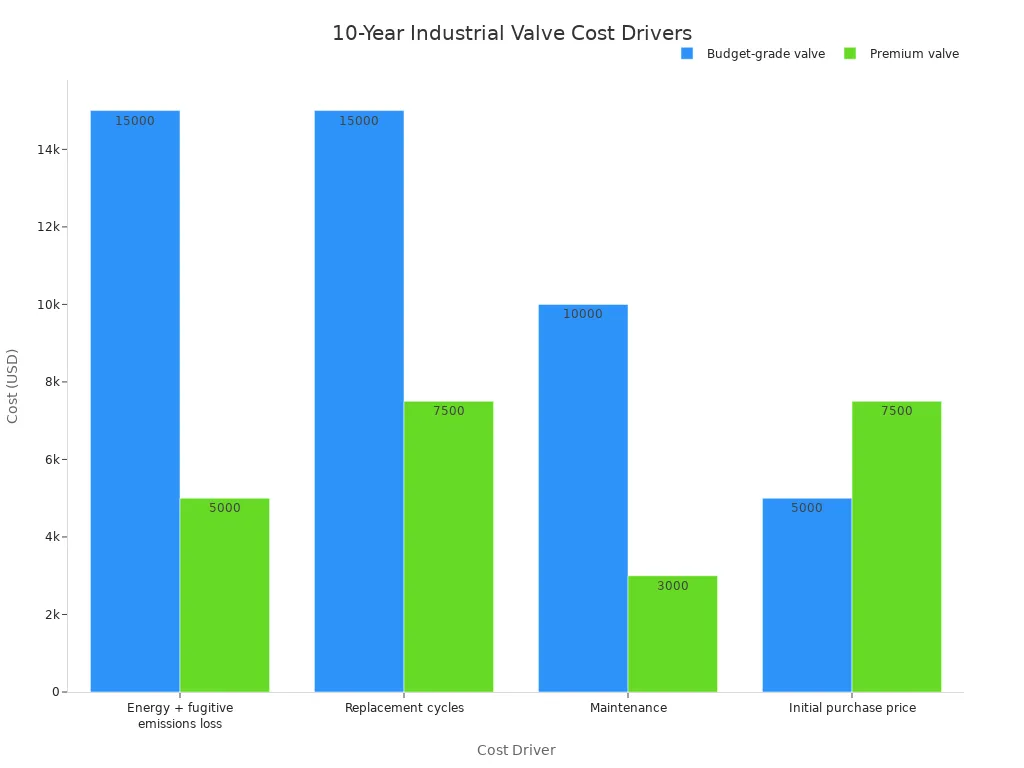
Look beyond upfront price tags when choosing factory equipment. The original cost accounts for only 10% to 15% of a valve's true cost over ten full years. Partnering with a reliable control valve supplier slashes long-term expenses and keeps severe process loops running much longer without breaking.
Well-made valves prevent constant repair cycles, ongoing maintenance headaches, and sudden factory shutdowns. Cheap valves can cost around $70,000 over ten years because they break often and pause production. Quality industrial valves need far fewer repairs, holding total ten-year operating costs near $20,000 for manufacturing facilities.
Energy Loss and Tight Shut-Off
Inner seat leaks waste valuable energy continuously across your facility's pipe networks. Tight shut-off performance stops precious steam, fuel, and liquid chemicals from leaking away during daily plant operations. Stopping these leaks maintains correct system pressure while protecting downstream pipes from early wear.
Working with an expert control valve supplier guarantees you pick the correct ANSI shutoff class for your piping loops. High-grade seal designs lower energy waste, stop seat damage, and block dangerous emissions throughout long production runs. Smart choices keep systems running smoothly and protect company profits.
Supply Chain and Delivery Resilience
Global Logistics and Inventory
Shortages of basic materials often delay valve production and slow down final delivery schedules. For example, changing plastic supplies can push back orders by 18 percent since raw materials account for 31 percent of total building costs. Global supply delays require extra planning from purchasing teams.
A trusted control valve supplier keeps extra raw materials on hand and signs smart vendor deals to safeguard your deadlines. Top Chinese factories ship finished goods in 25 to 35 days and accept custom orders as small as one big industrial valve.
Rapid Fast-Track Turnarounds
Engineers need clear safety stock math to shield critical pipe systems from unexpected factory shutdowns. Facilities calculate proper spare parts inventory using this basic formula: safety stock = safety factor x square root of (lead time x demand variance demand squared x lead time variance).
Set a safety factor Z score of 2.33 for essential parts to maintain 99% coverage during emergencies. Keeping 3 to 4 weeks of critical spares lets your primary control valve supplier handle urgent repairs and avoid expensive factory downtime.
Maintenance, Spare Parts, and Field Support
Proper maintenance practices prolong equipment service life and preserve flow control accuracy. Plant operators protect production lines by combining proactive site diagnostics with structured spare parts management.
Field Commissioning and Services
On-Site Diagnostic Audits
You must run regular field diagnostic audits to catch mechanical wear early. Intelligent positioners collect real-time actuator data, revealing internal stiction, deadband, and packing friction before dynamic control fails. Process engineers set testing schedules based on service criticality. High-cycle applications need monthly inspections, while standard valves undergo annual service checks.
|
Audit Focus Area |
Diagnostic Best Practice |
Operational Goal |
|---|---|---|
|
Visual Inspection |
Check valve body, bonnet, and flanges for leaks or corrosion. |
Stop external leaks and loose bolts. |
|
Predictive Testing |
Monitor positioner data, stroke time, and dynamic torque. |
Detect stiction and internal wear. |
|
Baseline Logs |
Record historical stroke times and seat tightness values. |
Track performance shifts over time. |
Technicians cycle valves fully during operational testing to detect unexpected sticking, positioner mismatches, or abnormal acoustic emissions. Your control valve supplier helps establish baseline logs. These detailed history files track operating torque and seat tightness, supporting clear condition-based maintenance decisions.
Emergency Outage Support
Emergency shutdown readiness protects critical refinery processes from unplanned events. Field technicians inspect emergency shutdown assemblies regularly to confirm proper actuation speed and zero-emission isolation performance. You integrate these checks directly into your predictive workflow to avoid sudden pressure excursions.
Unplanned outages require fast action from trained engineering teams. Working with a reliable control valve supplier gives you access to 24/7 emergency dispatch services. Dedicated technicians restore active plant operation quickly through directed rebuilds, rapid diagnostic troubleshooting, and on-site field support.
Spare Parts and Lifecycle Management
Standardized Trim Kit Availability
Smart valve designs feature field-replaceable trim components. Media wear impacts only the inner plug, seat plate, and cage. Technicians replace worn trim parts on-site, restoring proper performance without replacing the main body casting. This capability cuts total replacement expenses substantially.
Standardizing actuator mounting interfaces like NAMUR or ISO standards simplifies spare parts inventory across your entire facility. You can upgrade positioners or accessories independently without changing the actuator body. Quick trim replacements minimize costly system downtime during unexpected process outages.
Obsolescence Protection Plans
You minimize component supply risks by implementing formal obsolescence protection plans under IEC 62402 standards. Monitor vendor end-of-life notices continuously to establish last-time-buy windows for critical internal hardware.
-
Standardize interfaces to avoid single-vendor locking and simplify inventory sourcing.
-
Specify control hardware by performance criteria rather than sole-source brand names.
-
Maintain strategic buffer stock for severe-service production lines.
Holding strategic buffer stock shields critical process loops from unexpected supply chain delays. Dual-sourcing strategy allows faster parts procurement during major plant turnarounds, reducing your total cost of ownership.
Choosing Top Control Valve Makers in 2026
Picking top control valve makers needs a clear plan in 2026. You must look past simple prices. You need suppliers who deliver strong tech standards, steady builds, and long support. Process engineers protect plant work by testing makers with clear performance steps.
Supplier Scorecard Steps
Creating a scorecard makes grading different control valve makers easy. A plain setup stops unfair buying choices. You can rank suppliers using weighted tech and business metrics.
Tech Response Metrics
Fast engineering help stops project delays while sizing and choosing parts. You must check how quickly a supplier answers tough tech questions. Top control valve makers answer process questions within 24 hours. They share full flow math built on IEC 60534 rules.
Your review needs to grade makers on how they fix tough process problems:
-
Cavitation and flashing risk checks while sizing pipe lines.
-
Material advice for harsh or scraping liquids and gases.
-
Smart positioner choices for complex digital control loops.
Skilled suppliers review your flow sheets with care. They run accurate sizing math to stop picking oversized or undersized valves. You prevent jumpy control loops and early seat damage by demanding full tech checks before buying.
On-Time Shipping and Quality Rates
Work schedules count on solid plant build times. You should track on-time shipping history across past factory orders. Solid control valve suppliers keep on-time delivery rates above 95 percent. Late shipments hold up plant starts and waste worker time.
Quality checks prove factory steady work before hardware leaves the shop. You must ask for factory test reports for every built unit.
|
Quality Metric |
Industry Goal Level |
How to Check |
|---|---|---|
|
Hydro Shell Test Pass Rate |
100% pass |
Pressure tests using API 598 rules |
|
Seat Leak Pass Rate |
Zero failures |
ANSI/FCI 70-2 bubble or water collection tests |
|
On-Time Shipping Rate |
95% or higher |
Shipping logs and factory tracking |
Top makers use ISO 9001:2015 quality setups. They run non-destructive tests on raw metal to catch hidden product flaws.
Strategic Partner Setup
Short-term buyer plans raise risks during emergency plant stops. You should build a strong working partnership with key suppliers. Close teamwork improves valve work and drops overall maintenance expenses across plant lifespans.
Shared Project Engineering
Shared engineering builds custom valve options for your special flow needs. Your plant engineers team up with supplier tech groups during early design phases. This teamwork guarantees right trim choices for big pressure drops or extreme heat shifts.
Custom makers shape cage-guided trims to fit unique flow needs. TANGGONG VALVE provides free valve sizing math and custom trim design for hard chemical, refining, and power plant loops. Shared design checks stop piping errors before casting and machining start. They also verify actuator sizes under worst air pressure drops. Early planning cuts fix costs and speeds up field starts.
Long-Term Service Contracts
Long-term service contracts set clear support promises across your valve fleet's full working life. You secure fixed prices for standard trim replacement sets and regular fix jobs.
A clear service agreement locks in priority emergency visits and guarantees spare parts during sudden plant stops.
Your contract must cover clear work promises:
-
Promised stock counts for key stem packings, plugs, and cages.
-
Fast worker dispatch times during forced plant stops.
-
Set health check schedules using smart positioner data.
Teaming up with proven valve makers protects your plant against old parts under IEC 62402 rules. Suppliers store tech blueprints and metal molds for decades. Long-term contracts smooth out buying tasks, lower storage costs, and boost overall plant run time.
Choosing great control valve makers in 2026 takes careful review of main design rules, safety badges, and low long-term costs. You must check pressure limits, exact flow speeds, safety code rules, and smart controllers to lower factory downtime. As a trusted custom valve maker, TANGGONG VALVE pairs 36 years of building experience with sales across 35 countries. Every valve passes tough water pressure checks and seat leak tests to ensure safe work in harsh factory setups. Call our engineering team today to ask for your free valve sizing check and get expert tech help for your plant.
FAQ
What is the main difference between a control valve and an isolation valve?
Control valves continuously adjust liquid levels to keep systems running smoothly based on automated signals. Isolation valves operate simple start and stop actions by turning completely on or completely off.
How do pneumatic and electric control valve actuators differ?
Pneumatic actuators run on squeezed air, making them fast and safe to use inside dangerous gas areas. Electric actuators use simple motor power, offering exact positioning for automated factories without air systems.
What benefits does cage-guided trim provide in severe service applications?
Cage-guided trim uses a hollow cylinder full of small holes to hold the inner plug straight. This smart design cuts shaking, quiets loud liquid noise, stops bubble damage, and keeps parts working longer.
How do process engineers size control valves correctly for complex systems?
Engineers compute size needs using fluid details, flow amounts, heat levels, and pressure drops following IEC 60534 rules. TANGGONG VALVE offers free sizing help under these standard guidelines to help you pick correctly.
Which international quality and safety certifications apply to TANGGONG control valves?
TANGGONG control valves carry ISO 9001:2015, CE, and SGS safety marks. Factory workers test every finished piece using strict API 598 and ANSI/FCI 70-2 methods to ensure reliable safety up to SIL ratings under IEC 61508.
What operating temperatures and pressure classes do TANGGONG control valves support?
TANGGONG control valves handle standard pressure levels starting at Class 150 up to Class 2500 (PN10 to PN420). Tough body metals and special stem seals easily sustain extreme heat shifts from -196°C to 650°C.